This is great! Where can I get more? Sign-Up over here! ---------------------------------->
We work with a lot of HS athletes preparing for that transition to college and it's always a fun and stressful time for these athletes as they look for a place to spend the next chapter of their life.
I remember going through the recruiting process and thinking what the hell am I going to do? How can I tell the difference between all these schools?
When I look back, it's one of those - I wish I knew then, what I know now.
Athletes and parents often go into these situations not really knowing what to look for and this can make the whole process really sticky.
Two months ago, we were lucky enough to have 3 area coaches come in and talk to our athletes about things they can be doing to help their chance to play college ball. It was great opportunity for our athletes to hear directly from these college coaches on what they look for and what athletes should look for when choosing a school.
Below we've compiled some of the most important questions athletes and parents need to know before making this big decision.
Take a look at these and have a plan during these exciting times. It will save a lot of headache and solve some potential problems choosing a school.
Education
- Do they have the academic programs/degree you want?
- Do they have a solid academic support staff in place? Will you have access to tutors?
- What is the team's graduation rate?
- Are there alumni that studied in your degree field and what are they doing now? Can you talk to them?
- What was the team's average GPA?
- Do the coaches oversee and look over your grades or will you be on your own?
- Is their an independent academic standard (aside from the NCAA's) that you need to reach in order to play?
Athletic
- Will you have an opportunity to play right away? If not, are you ok waiting 1, 2, maybe 3 years before playing?
- How would the coaching staff describe their coaching style? Can you see yourself being coach as such?
- Did you meet the strength and conditioning coach? What is his/her approach to training both in-season and off-season? (You’ll be spending a lot of time with this coach)
- Have you watched this team play a game and practice? (Let me tell you, college is a heck of a lot different than HS in both practice and game tempo, intensity, etc)
- Did you meet the assistant or position coaches? They'll often be the ones coaching you far more than the head coach will be.
- Does the coaching staff get out and attend or speak at different conferences to improve at their craft? I can tell you I'd much rather be part of a program that is continually trying to find better more successful ways to coach and plan for me as an athlete and as a team, rather than just be stuck in their ways.
Miscellaneous
- What is a program's track record in terms of injury rates? This is especially important for sports like baseball, soccer, basketball. Are the same injuries occurring every year like ACL, UCL tears? If so, this may mean something is going on that increases risk of these injuries ie over-use, poor training models, dangerous practice habits, etc. You don't want to become one of these statistics, so know if you're a pitcher and every year they have guys having Tommy John Surgery, a red flag needs to go off.
- How tough of an adjustment, socially will it be for you? This is HUGE! You'll be spending the next 4-5 years of your life in this city/community. Will you fit in? Is it too far or too close to home? Is the social environment enough or too much for you?
- Is it public or private? This may seem weird, but there are usually some vast differences between a public vs private university. Most private institutions have some sort of religious background and this may mean mandatory religious education classes, required weekly mass, living on-campus for 2-3 years, no opposite sex in dorm rooms, required class attendance, dry campus, more expensive tuition, etc. Public institutions tend to be more open and allow more freedom than private institutions, but on the same hand they tend to be larger, provide less "intimate" education (larger classes, less hands on advising), and often don't require attendance to class. Overall each option provides different pros and cons, know them.
- How much is tuition? Can you get grants, scholarships, or help paying this? With today's cost of college education, this question needs to be asked. A school may look great and everything, but is it worth paying off 100K for the next 20-years of your life?
Hope this helps all those aspiring athletes gain clarification as they choose their college. Making a great decision at this junction will determine many things in an athletes future. Be sure to leave no stone un-turned and know the details of your decision.
Go Get 'Em

Showing posts with label Softball. Show all posts
Showing posts with label Softball. Show all posts
Wednesday, October 15, 2014

Thursday, January 3, 2013
Rotational Sequencing and Power - Part 3
Alright time to conclude this series on Rotational Sequencing and Power. In case you missed the first 2 parts check them out here, Part one, Part two.
In this final part we are going to go into the details of the correct sequential patterns to enhance rotational power, efficiency, and safety.
Rotational movements require proper sequencing of the body through various parts. This does not happen naturally for all athletes, and must be taught.
Athletes need the proper kinetic linking and sequencing to allow athletes to reach their maximum potential. Athletes need to learn how to
Load from the ground up
Lead movement with hips
Sequence energy through joints/muscles
Movement should look like a whip
Be able to separate hips from upper body and shoulders
Take a look at these pictures again and look at the athletes hips compared to their shoulders


Their hips lead their upper body and shoulders. They get their power from their hips, and they use the mobility and stability to transfer that power to their implement.
This, in a nut shell, is rotational sequencing.
The athlete loads up using thier hips and posterior muscle sling, and then unloads from the ground up, snapping their hips to transfer this force through their anterior muscle slings and onto the upper body and shoulders.
As we touched on in part 1 (TPI Rotational Sequence), this proper sequencing is what separates amateurs from the elite. Learning how to load and unload using the correct sequential pattern is key to creating more rotational power and speed.
Tony Mikla, during a webinar, dicussed how he trains two Olympic discuss throwers of very similar strength, speed, power, stability, and mobility standards. Except one of the throwers out performs the other by significant amounts.
How is this possible? They possess the similar physical abilities, but their performances are very different.
Dr. Mikla noted the difference was in the sequencing of these two athletes. Athlete A out performs Athlete B because she better utilizes the power she generates from her hips.
She doesn't have energy leaks and has proper sequencing from the ground up through her hips, onto her thorax, and finally to her arms.
Athlete B doesn't sequence correctly. She might have her torso lead first and then the hips and shoulders come next, simultaneously.
This funk it sequencing doesn't allow her to fully utilize the transfer of forces through her kinetic chain.
Essentially sequencing is technique, and proper technique separates athletes in all sports. We teach proper technique in all other exercises, but often times do not for rotational exercises.
We need to teach rotational movements and use progressions just like we do with all other exercises.
I like to use med ball variations when training rotational power as they allow for great velocity. Use the rotational stability exercises mentioned in part 2 for gaining strength and stability. This step cannot be skipped! If you do, you are setting your athletes up for injury. Progress correctly!
Use dynamic med ball work for enhancing rotational power and sequencing. No need to use an overally heavy med ball, 6-12lbs will typically do for most rotational movements. Remember, besides the shot put, sports do not use heavy implements, it's about creating higher speeds and forces into our movements.
Lateral MB Punch
I find this as the easiest progression to teach to correct sequential pattern. With the med ball close the body it reduces any kind of lever arm, and makes the whole movement easier to perform and learn.
Load the ball in the back armpit, while also loading up the rear leg and posterior muscle sling. Press through the ground with the rear leg and lead the movement from the hips, through the torso, and finally through to the shoulders through to the ball.
Lateral Scoop Throws
Now we take the ball and place it away from the body. This creates more torque, but also allows a good picture of the sequence of the kinetic chain. Load up the back leg and transition from the ground up, through the ball.
Lateral Med Ball Slams
Another great OH movement to challenge top-down and the long lateral lines of the body.
Lateral Shuffle MB Punch
Now that we've established a solid base of rotational movements from a static position, we now move towards dynamic movements.
In sports, often times rotational movements require the athlete to continue to transfer force from the momentum and movement already built up. So here we start with a single shuffle pattern into a dynamic lateral punch. Kind of like the glide technique in the shot-put.
Use the momentum and speed built up to transfer that force into the rotational movement. The same sequencing and patterns still apply even though the speed of the movement is greater.
Crossover MB Punch
I've helped coach a couple of kids for sport showcase type events like pro-agility
(5-10-5), 60 yard dash, and L-Drill (3-cone). These drills require crossover steps, and this drill simulates gaining power and movement from a crossover position.
Moving Crossover MB Punch
Next we like to move into our moving crossover and punch movement. Just think about how many times athletes are required to cross their feet over in their sport. Baseball, soccer, football, basketball, and volleyball all require athletes to crossover into a sprint or some other movement. Here we get to work on that quality.
MB Drop Step Punch
This is something fun and challenging for your athletes to do. It really challenges spatial awareness, coordination, and 180 degree rotational qualities. This has tremendous carryover to throwing events, basketball, and any sport that requires these types of turns (DB in football, Centerfielder turning on a deep fly ball, etc)
Well there you have it. That's the series on developing rotational sequencing and power. Learning the correct pattern of rotational sequence might be separating you and your athletes from further success, oh and like I said before, developing rotational power = hot women asking you out for dates, it's science!
So take and use what you can and as always Go Get 'Em!
Like, Dislike, Agree, Disagree, WORLD CHANGING, or a big turd; whatever you feel, leave a comment below and let me know!
In this final part we are going to go into the details of the correct sequential patterns to enhance rotational power, efficiency, and safety.
Proper Sequencing
Rotational movements require proper sequencing of the body through various parts. This does not happen naturally for all athletes, and must be taught.
Athletes need the proper kinetic linking and sequencing to allow athletes to reach their maximum potential. Athletes need to learn how to
Load from the ground up
Lead movement with hips
Sequence energy through joints/muscles
Movement should look like a whip
Be able to separate hips from upper body and shoulders
Take a look at these pictures again and look at the athletes hips compared to their shoulders

Their hips lead their upper body and shoulders. They get their power from their hips, and they use the mobility and stability to transfer that power to their implement.
This, in a nut shell, is rotational sequencing.
The athlete loads up using thier hips and posterior muscle sling, and then unloads from the ground up, snapping their hips to transfer this force through their anterior muscle slings and onto the upper body and shoulders.
As we touched on in part 1 (TPI Rotational Sequence), this proper sequencing is what separates amateurs from the elite. Learning how to load and unload using the correct sequential pattern is key to creating more rotational power and speed.
Tony Mikla, during a webinar, dicussed how he trains two Olympic discuss throwers of very similar strength, speed, power, stability, and mobility standards. Except one of the throwers out performs the other by significant amounts.
How is this possible? They possess the similar physical abilities, but their performances are very different.
Dr. Mikla noted the difference was in the sequencing of these two athletes. Athlete A out performs Athlete B because she better utilizes the power she generates from her hips.
She doesn't have energy leaks and has proper sequencing from the ground up through her hips, onto her thorax, and finally to her arms.
Athlete B doesn't sequence correctly. She might have her torso lead first and then the hips and shoulders come next, simultaneously.
This funk it sequencing doesn't allow her to fully utilize the transfer of forces through her kinetic chain.
Essentially sequencing is technique, and proper technique separates athletes in all sports. We teach proper technique in all other exercises, but often times do not for rotational exercises.
We need to teach rotational movements and use progressions just like we do with all other exercises.
Getting After It
I like to use med ball variations when training rotational power as they allow for great velocity. Use the rotational stability exercises mentioned in part 2 for gaining strength and stability. This step cannot be skipped! If you do, you are setting your athletes up for injury. Progress correctly!
Use dynamic med ball work for enhancing rotational power and sequencing. No need to use an overally heavy med ball, 6-12lbs will typically do for most rotational movements. Remember, besides the shot put, sports do not use heavy implements, it's about creating higher speeds and forces into our movements.
Lateral MB Punch
I find this as the easiest progression to teach to correct sequential pattern. With the med ball close the body it reduces any kind of lever arm, and makes the whole movement easier to perform and learn.
Load the ball in the back armpit, while also loading up the rear leg and posterior muscle sling. Press through the ground with the rear leg and lead the movement from the hips, through the torso, and finally through to the shoulders through to the ball.
Lateral Scoop Throws
Now we take the ball and place it away from the body. This creates more torque, but also allows a good picture of the sequence of the kinetic chain. Load up the back leg and transition from the ground up, through the ball.
Parallel Scoop Throws
Parallel throws really separate the hips from the shoulders. It's a little tougher to get the hips to rotate thoroughly, but requires great amounts of mobility in the T-Spine, hips, and ankle. It also requires great strength and stability through the hips and trunk to get adequate rotation and power.
Split Stance Lateral/Parallel Scoop Throws
The split stance take the hips slighty out of the movement, but it forces the athlete to create rotational force through a unilateral position. The hips must be stable, and the athlete must keep a solid base for rotation to revolve around.
Lateral OH Slams
OH slams place the load in a different position and challenges the athlete in a top-down pattern. This puts a ton of stress on that anterior muscle sling, and will really lengthen the lateral components of the body.
Lateral Med Ball Slams
Another great OH movement to challenge top-down and the long lateral lines of the body.
Lateral Shuffle MB Punch
Now that we've established a solid base of rotational movements from a static position, we now move towards dynamic movements.
In sports, often times rotational movements require the athlete to continue to transfer force from the momentum and movement already built up. So here we start with a single shuffle pattern into a dynamic lateral punch. Kind of like the glide technique in the shot-put.
Use the momentum and speed built up to transfer that force into the rotational movement. The same sequencing and patterns still apply even though the speed of the movement is greater.
Crossover MB Punch
I've helped coach a couple of kids for sport showcase type events like pro-agility
(5-10-5), 60 yard dash, and L-Drill (3-cone). These drills require crossover steps, and this drill simulates gaining power and movement from a crossover position.
Moving Crossover MB Punch
Next we like to move into our moving crossover and punch movement. Just think about how many times athletes are required to cross their feet over in their sport. Baseball, soccer, football, basketball, and volleyball all require athletes to crossover into a sprint or some other movement. Here we get to work on that quality.
MB Drop Step Punch
This is something fun and challenging for your athletes to do. It really challenges spatial awareness, coordination, and 180 degree rotational qualities. This has tremendous carryover to throwing events, basketball, and any sport that requires these types of turns (DB in football, Centerfielder turning on a deep fly ball, etc)
Well there you have it. That's the series on developing rotational sequencing and power. Learning the correct pattern of rotational sequence might be separating you and your athletes from further success, oh and like I said before, developing rotational power = hot women asking you out for dates, it's science!
So take and use what you can and as always Go Get 'Em!
Like, Dislike, Agree, Disagree, WORLD CHANGING, or a big turd; whatever you feel, leave a comment below and let me know!
Thursday, December 20, 2012
Rotational Sequencing and Power - Part 2
If you missed part 1
Continuing on from part 1, we're now going to focus on the steps to develop correct rotational sequencing and power.
Jason Glass puts it perfectly when he says, "You have to earn the right to rotate".
Dynmaic rotational movements are highly coordinated and technical movements, and they require great deals of strength, stability, mobility, and coordination.
You would never take a new athlete and throw them in the squat rack with 2x their body weight.
Instead you'd progress them and groove the squat pattern until they show proper mechanics, strength, mobility, and stability.
Just as so, an athlete needs to exhibit proper stability and mobility before they can move on to dynamic rotational movements.
If you do not have the proper stabilization and strength in a static position, than performing dynamic rotational movements will just lead to dysfunction, improper sequencing, and increased risk of injury.
The same goes for adequate mobility. Rotational movements require a great deal of mobility especially in the thoracic spine, internal/external hip rotators, and ankles.
Just like having limited stability can create issues; a lack of mobility will not allow the athlete to reach their maximum power, sequencing, and again will increased risk of injury.
So to earn the right to rotate, it is important that we as coaches make sure we evaluate our athletes to ensure they possess adequate levels of stability and mobility.
If there is a lack of mobility or ROM in a certain joint or side of the body, you know you must plan to attack that area with proper mobility drills.
Thoracic Spine - Athletes need to have adequate rotation and extension in the thoracic spine. When looking at ROM, the T-spine should be able to get 30 degrees or more of rotation, and the athlete should be able to get proper extension from the T-spine without stealing it from the lumbar spine.
Make sure to use mobility movements that keep the lumbar spine fixed, so selecting an exercise that "locks" the lumbar spine down ensures it will not be involved with thoracic spine movements.
Hips - The hips are a very mobile joint, so you must evaluate it in many different movements and angles. Flexion (120+ degress), extension (15+ degrees), adduction, and abduction are important, but even more important for rotational athletes is internal and external rotation.
With rotation occuring in the transverse plane, internal and external mobility and strength become very important. Here is an article on hip internal rotation, and here is one on glute medius mobility (largely external rotation).
As an athlete loads during rotational movements, the rear hip goes through internal rotation and front hip external rotation. As the athlete starts to un-coil the rear hip now goes through powerful external rotation and the front hip absorbs into internal rotation. If there are extreme limitations or restrictions into either of these movements you will see compensation patterns arise, spinal rotation instead of hip rotation, and loss of power.
Also, just as in overhead throwing, if the tissues surrounding the hip aren't kept healthy and happy, they can get beat up from these movements. So, if we have a rotational athlete, ensuring we are getting adequate time spent on soft-tissue and mobility of the internal and external rotators is extremely important.
Ankles- The ankles are just like the hips, a very mobile joint. The ankles require a great deal of dorsiflexion, plantarflexion, inversion, and eversion.
Kneel next to a wall, with one foot 4 inches away from ithe wall. Keeping the heel on the ground, press the knee towards the wall. If the athlete cannot touch the wall, the athlete lacks dorsiflexion (A large percentage of people lack dorsiflexion). They are probably compensating linear movements because of this lack of dorsiflexion and are not getting proper foot and ankle function.
The athlete should also have atleast 20 degrees of inversion and 5 degrees of eversion. As we will go into later, many rotational movements (and most movements overall) require movement around the ankle joint to help transfer force or transfer rotatation to allow better positions.
Many great improvements are seen when athletes take off their shoes. I'm not recommending going straight in to a barefoot badass, I'm hinting at do warm-ups and select exercises barefoot to help improve the function on you feet and ankles.
Stability
The athlete also needs to show proper stability and strength in not only the transverse plane, but also the frontal and sagittal planes. Here are some exercises athletes need to show proper stability before they should progress to higher velocities or resistance of rotational movements.
Bird-Dog - This is actually a test from the FMS, called rotary stability (see rotary = rotation! You need this). You are looking to see if the athlete can maintain correct posture and stability while performing this exercise.
If they consistantly wobble, sway, or lose position, then they need work on improving their bodies stability. This opposite arm-leg movement stresses the fascia lines of our body in a very rotational way. Test both sides, and note any differences.
Push-Up w/ Arm Reach - Like the Bird-Dog, except now the athlete has smaller areas of contact with the ground, thus stressing more need for stability.
From side or behind views we should not see a major shift in body position. They athlete should look the same as they do in the starting position. Again test both sides and note any differences.
Inverted Bridge w/ Arm Reach - The previous two tests assessed anterior stability and the anterior muscle slings. The Inverted Bridge w/ Arm Reach will test posterior stability and the posterior muscle sling.
Set up a bar or rings about 4.5 to 5 feet in the air. Grab the bar and assume a lifted bridge position, so that your stomach is flat like a table. Make sure the athletes takes a shoulder width apart grip, and sets their body, core tight - glutes squeezed - shoulders pulled back, for the movement.
Remove one hand from the bar, and reach towards the opposite shoulder, just as you did in the push-up. The athlete should be able to maintain position without major shifts or swings. Test both sides and note any differences.
Glute March - The Glute March will also test the posterior components of the body, with more emphasis through the glutes. We need this stability and strength throught our glutes because the glutes are the engine that fuel our powerful hip movements.
The athlete starts in a glute bridge position, the athlete then "marches" in place, alternating between lifting legs. This will show any weaknesses throughout the glutes and lumbopelvic-hip complex. Notice any differences between sides as usual.
Cable Chops and Lifts - Finally we move to Cable/Band Chops and Lifts. This is a great way to move from static stabilization to more of a dynamic stabilization. The core and hip stability are challenged to transfer the weight thoughout this movement. Use both tall kneeling and half kneeling variations to challenge unilateral stability and strength.
Stay tall throughout this whole movement; think about not becoming "shorter". Also keep your hips and pelvis square, and let your shoulders and arms move the weight throughout the range of motion. Keeping your torso square allows the force to be transfered through your core and hips onto your arms.
Like we touched on at the beginning, athletes need to master these stabilization and mobility exercises before we throw them into dynamics and loaded rotational movements.
If they do not possess these qualitites before starting dynamic rotational movements, then we are setting them up to added dysfunction on improper movement patterns, injury, lessend performance, and oh did I mention injury!
It never pays to rush into exercises because they are cool and fun. Take the proper progression and steps to set your athletes up for the long run.
Part 3 will dive into adding speed to rotation, really the meat and potatoes of what we think of when improving rotational abilities.
Until then Go Get 'Em!
Continuing on from part 1, we're now going to focus on the steps to develop correct rotational sequencing and power.
Jason Glass puts it perfectly when he says, "You have to earn the right to rotate".
Dynmaic rotational movements are highly coordinated and technical movements, and they require great deals of strength, stability, mobility, and coordination.
You would never take a new athlete and throw them in the squat rack with 2x their body weight.
Instead you'd progress them and groove the squat pattern until they show proper mechanics, strength, mobility, and stability.
Just as so, an athlete needs to exhibit proper stability and mobility before they can move on to dynamic rotational movements.
If you do not have the proper stabilization and strength in a static position, than performing dynamic rotational movements will just lead to dysfunction, improper sequencing, and increased risk of injury.
The same goes for adequate mobility. Rotational movements require a great deal of mobility especially in the thoracic spine, internal/external hip rotators, and ankles.
Just like having limited stability can create issues; a lack of mobility will not allow the athlete to reach their maximum power, sequencing, and again will increased risk of injury.
So to earn the right to rotate, it is important that we as coaches make sure we evaluate our athletes to ensure they possess adequate levels of stability and mobility.
Mobility
When testing and evaluating mobility, it is important to make sure there are no major limitations or differences between sides of the body. The athlete should exhibit adequate levels of ROM in the major joints, and through total body movements.If there is a lack of mobility or ROM in a certain joint or side of the body, you know you must plan to attack that area with proper mobility drills.
Thoracic Spine - Athletes need to have adequate rotation and extension in the thoracic spine. When looking at ROM, the T-spine should be able to get 30 degrees or more of rotation, and the athlete should be able to get proper extension from the T-spine without stealing it from the lumbar spine.
Make sure to use mobility movements that keep the lumbar spine fixed, so selecting an exercise that "locks" the lumbar spine down ensures it will not be involved with thoracic spine movements.
Hips - The hips are a very mobile joint, so you must evaluate it in many different movements and angles. Flexion (120+ degress), extension (15+ degrees), adduction, and abduction are important, but even more important for rotational athletes is internal and external rotation.
With rotation occuring in the transverse plane, internal and external mobility and strength become very important. Here is an article on hip internal rotation, and here is one on glute medius mobility (largely external rotation).
As an athlete loads during rotational movements, the rear hip goes through internal rotation and front hip external rotation. As the athlete starts to un-coil the rear hip now goes through powerful external rotation and the front hip absorbs into internal rotation. If there are extreme limitations or restrictions into either of these movements you will see compensation patterns arise, spinal rotation instead of hip rotation, and loss of power.
Also, just as in overhead throwing, if the tissues surrounding the hip aren't kept healthy and happy, they can get beat up from these movements. So, if we have a rotational athlete, ensuring we are getting adequate time spent on soft-tissue and mobility of the internal and external rotators is extremely important.
Ankles- The ankles are just like the hips, a very mobile joint. The ankles require a great deal of dorsiflexion, plantarflexion, inversion, and eversion.
Kneel next to a wall, with one foot 4 inches away from ithe wall. Keeping the heel on the ground, press the knee towards the wall. If the athlete cannot touch the wall, the athlete lacks dorsiflexion (A large percentage of people lack dorsiflexion). They are probably compensating linear movements because of this lack of dorsiflexion and are not getting proper foot and ankle function.
The athlete should also have atleast 20 degrees of inversion and 5 degrees of eversion. As we will go into later, many rotational movements (and most movements overall) require movement around the ankle joint to help transfer force or transfer rotatation to allow better positions.
Many great improvements are seen when athletes take off their shoes. I'm not recommending going straight in to a barefoot badass, I'm hinting at do warm-ups and select exercises barefoot to help improve the function on you feet and ankles.
Stability
The athlete also needs to show proper stability and strength in not only the transverse plane, but also the frontal and sagittal planes. Here are some exercises athletes need to show proper stability before they should progress to higher velocities or resistance of rotational movements.
Bird-Dog - This is actually a test from the FMS, called rotary stability (see rotary = rotation! You need this). You are looking to see if the athlete can maintain correct posture and stability while performing this exercise.
If they consistantly wobble, sway, or lose position, then they need work on improving their bodies stability. This opposite arm-leg movement stresses the fascia lines of our body in a very rotational way. Test both sides, and note any differences.
Push-Up w/ Arm Reach - Like the Bird-Dog, except now the athlete has smaller areas of contact with the ground, thus stressing more need for stability.
From side or behind views we should not see a major shift in body position. They athlete should look the same as they do in the starting position. Again test both sides and note any differences.
Inverted Bridge w/ Arm Reach - The previous two tests assessed anterior stability and the anterior muscle slings. The Inverted Bridge w/ Arm Reach will test posterior stability and the posterior muscle sling.
Set up a bar or rings about 4.5 to 5 feet in the air. Grab the bar and assume a lifted bridge position, so that your stomach is flat like a table. Make sure the athletes takes a shoulder width apart grip, and sets their body, core tight - glutes squeezed - shoulders pulled back, for the movement.
Remove one hand from the bar, and reach towards the opposite shoulder, just as you did in the push-up. The athlete should be able to maintain position without major shifts or swings. Test both sides and note any differences.
Glute March - The Glute March will also test the posterior components of the body, with more emphasis through the glutes. We need this stability and strength throught our glutes because the glutes are the engine that fuel our powerful hip movements.
The athlete starts in a glute bridge position, the athlete then "marches" in place, alternating between lifting legs. This will show any weaknesses throughout the glutes and lumbopelvic-hip complex. Notice any differences between sides as usual.
Cable Chops and Lifts - Finally we move to Cable/Band Chops and Lifts. This is a great way to move from static stabilization to more of a dynamic stabilization. The core and hip stability are challenged to transfer the weight thoughout this movement. Use both tall kneeling and half kneeling variations to challenge unilateral stability and strength.
Stay tall throughout this whole movement; think about not becoming "shorter". Also keep your hips and pelvis square, and let your shoulders and arms move the weight throughout the range of motion. Keeping your torso square allows the force to be transfered through your core and hips onto your arms.
Like we touched on at the beginning, athletes need to master these stabilization and mobility exercises before we throw them into dynamics and loaded rotational movements.
If they do not possess these qualitites before starting dynamic rotational movements, then we are setting them up to added dysfunction on improper movement patterns, injury, lessend performance, and oh did I mention injury!
It never pays to rush into exercises because they are cool and fun. Take the proper progression and steps to set your athletes up for the long run.
Part 3 will dive into adding speed to rotation, really the meat and potatoes of what we think of when improving rotational abilities.
Until then Go Get 'Em!
Monday, December 17, 2012
Rotational Sequencing and Power - Part 1
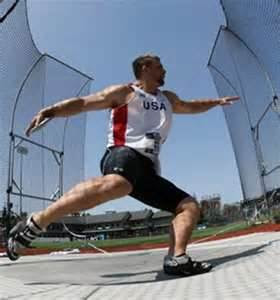
We watch many different athletes, sports, and activities and don't always realized the connections many of these have to each other. Take a look at these athletes and see what they have in common.



Like, Dislike, Agree, Disagree, WORLD CHANGING, or a big turd; whatever you feel, leave a comment below and let me know!


Not only do these athletes make these movements look so smooth and effortless, but their movements are very similar despite the major differences in their sport.
So what is it do they have in common?
Rotation! Rotational movements occur in just about every sport we play. Except for just plane old linear movements like sprinting or jogging, every other sport we participate in requires a great deal of roational sequencing and power.
Say you're playing football, it's 3rd and 3, late in the 4th quarter and you're on defense. The offense runs an outside zone play and you take an angle to cut off the running back at the 1st down marker.
You collison the running back with your head in behind of him (come one, get your head in front!), just shy of the 1st down marker. He has momentum and so do you, but who's gonna win? Well it comes down to a number of things, but a big one being your rotational strength and power.
Who's gonna win this battle!?
The one with more rotational power!
See when you collide, the running backs momentum creates a high force in the transverse plane of your body. You must counter this force with high rotational force opposite of where he is going.
Unless you have adequate rotational strength and power, the offense will move the sticks and win the game. But if your training regime exposes you to proper rotational training, you'll make the tackle, save the day, and get asked out by the best looking girl in school!
So to make sure you get asked out my the hottest girl in school, you need to make sure you get to working on your rotational power. I mean it's been studied that if you have lots of roational strength, you get asked out by better looking girls...it's science.
What is Rotational Movement
Rotational movements take place in the transverse plane. The transverse plane involves movements around a fixed axis. For most movements this fixed axis is our spine, and we rotate and move around the spine to create a rotational force.
Rotational movements involve a specific series of movements and motions that allow us to transfer the highest amount of forces. This proper sequencing is very critical in high performance.
In fact a study was done by the Titleist Performance Institute showed that the biggest difference between professional golfers from amateur golfers was their ability to develop roational speed and proper sequencing.
The development of higher rotational speeds is a pretty obvious difference as higher rotational speeds = further distance on shot. This is would be similar to the main difference between NFL receivers and non-NFL receivers is speed.
But the sequencing is a little surprising. The professional golfer showed a smooth, efficient sequence from muscle group to group throughout their swing, while the amateurs showed a sloppy, incorrect pattern of sequencing.
Many would think that the rotational sequence of hitting a golf ball would pretty consistant among all people, but that's not the case. Just like many other techniques, correct rotation patterns needs to be taught and learned. Rotational sequencing is an important skill to be learned and is essential for increasing ones rotational speed and power.
How Rotational Movement Works
Thomas Meyer's book Anatomy Trains has been a huge influence in the development of myofascial understanding and training. It is a must for anybody studying kinesiology. In it Thomas shows how the body is intertwined with connective tissues, and these tissues cross over the two halves of the body to create a crossed connection, very useful for rotational movements.
As you can see from the picture below your myofascial lines cross over the body to create significant connections from opposite sides of the body. Just one of the many outcomes from these findings is many times problems in a shoulder are caused or could be improved by focusing on the opposite hip or ankle.

Not only that, but we something called Muscle Slings, that also cross over the body. Jason Glass is in the forefront of rotational biomechanics and training. He has discussed how we have posterior and anterior muscle slings.
The posterior sling run from the lats (and really starts up at the posterior shoulder) - thoracolumbar fascia - glutes
The anterior sling run from the external obliques - internal obliques - adductor complex.
Muscle slings play a key role in developing and transfering rotational forces. They help to load and unwind forces and because of their design and attachment points, they are perfect for rotational movements.
The posterior sling run from the lats (and really starts up at the posterior shoulder) - thoracolumbar fascia - glutes
The anterior sling run from the external obliques - internal obliques - adductor complex.
Muscle slings play a key role in developing and transfering rotational forces. They help to load and unwind forces and because of their design and attachment points, they are perfect for rotational movements.
Anterior Muscle Sling Posterior Muscle Sling
These slings are also responsible for specific actions and movements during rotational exercises. Here they can be seen
The Anterior Sling - Flexion and Rotation
The Posterior Sling - Extension and Rotation
To go along with this, each sling as a particular role in loading and unwinding forces. The majority of loading falls upon the extension patterns, so the posterior sling. The majority of unwinding falls upon the flexion patterns, so the anterior sling.
Picture a golf swing. The backswing is the loading portion, and the posterior muscle sling loads up the body for the downswing. Then during the downswing, the anterior sling takes over and unwinds the force built up by the posterior sling to bring the club through the ball.
Not only that, these slings are also involved in decelerating rotational movements. So when you're slowing down and stopping say a pitch, swing, or discus throw, your muscle slings will work to decelerate these motions safely.
Not only that, these slings are also involved in decelerating rotational movements. So when you're slowing down and stopping say a pitch, swing, or discus throw, your muscle slings will work to decelerate these motions safely.
Now that you know what goes into rotational movements, we also need to know a proper progression on how to create this rotation and the requirements/skills athletes need before starting an intense rotational program.
In the next part of this series we will go into the stability and mobility requirements/progressions needed to safely and effectively perform high speed and high load rotational movements. Until then Go Get 'Em!
In the next part of this series we will go into the stability and mobility requirements/progressions needed to safely and effectively perform high speed and high load rotational movements. Until then Go Get 'Em!
Like, Dislike, Agree, Disagree, WORLD CHANGING, or a big turd; whatever you feel, leave a comment below and let me know!
Subscribe to:
Posts (Atom)